Addiction isn’t one-size-fits-all. Neither is treatment.
- Category: General, Mental Health
- Posted On:
- Written By: Boulder Community Health
Ask most people to picture substance use treatment and they have some variation of the same idea: a weeks-long residential stay in a facility, somewhere far away, after substance use has become unmanageable.
It can and does happen that way, but not all people with a history of substance misuse require such an intensive program. For many people suffering from addiction symptoms, a less intensive option is available with Recovery Toolbox course at Boulder Community Health (BCH).
How many people suffer from substance use without receiving care?
According to the 2024 National Survey on Drug Use and Health from the Substance Abuse and Mental Health Administration (SAMHSA), 48.4 million adults in the United States have a history of substance use in the past year. Just over half (55.8%) of those individuals have what’s considered a moderate case, and just under a quarter (22.8%) have a mild case of substance use.
Unfortunately, 80% of these adults who needed treatment did not receive care—and among these adults, 95.6% did not perceive a need for treatment. This means that over 36 million people are suffering without care.
And if the most common treatment options are intensive options for severe cases of substance use disorder (SUD), many of these adults may carry on assuming there are no options for them to manage milder cases of substance use.
Why do people suffering from substance use avoid getting care?
According to the 2024 SAMSHA study, the most common reason for not seeking help wasn't cost or access—75.5% of individuals who knew they needed help stated they believed they should have been able to handle their alcohol or drug use on their own, and 65% of respondents stated they were not ready to start treatment. Remaining reasons—in no significant order—include cost or insurance coverage, worry over what others would think or losing a job, concerns over information privacy and not knowing how or where to go for care.
These fears and concerns are understandable. Addiction is a sensitive mental health diagnosis, and at BCH we are committed to providing care for those with severe, moderate and mild cases of substance use. Our Behavioral Health services offer a variety of interventions that can reduce the impact on a person’s life or stop it from taking hold.
What are the substance use treatment options and the time commitment for each?
Clinically, treatment runs along a wide spectrum from outpatient to intensive outpatient, partial hospitalization, residential and inpatient. According to Behavioral Health professionals at BCH, what separates the levels are four practical factors: emphasis, environment, frequency, and duration.
- Inpatient care requires an in-facility stay at either a long or short-term secured facility. An example is the BCH Inpatient Behavioral Health unit.
- Residential care is an on-site living facility where the patient is engaging in at least 32+ hours of treatment a week.
- Partial hospitalization requires about five hours a day, five days a week in an outpatient setting located in a treatment environment.
- Intensive outpatient is roughly three hours, three days a week, for eight to twelve weeks in an outpatient clinical setting.
- The BCH Recovery Toolbox requires only 90 minutes, once a week in-person, for eight weeks.
While all these options treat substance use, each offers a different level of treatment based on the severity of the patient’s condition and symptoms. Treating substance use is not “one size fits all,” and our goal at BCH is to offer options for those with milder cases who have often not had many options for managing their substance use.
The BCH Recovery Toolbox
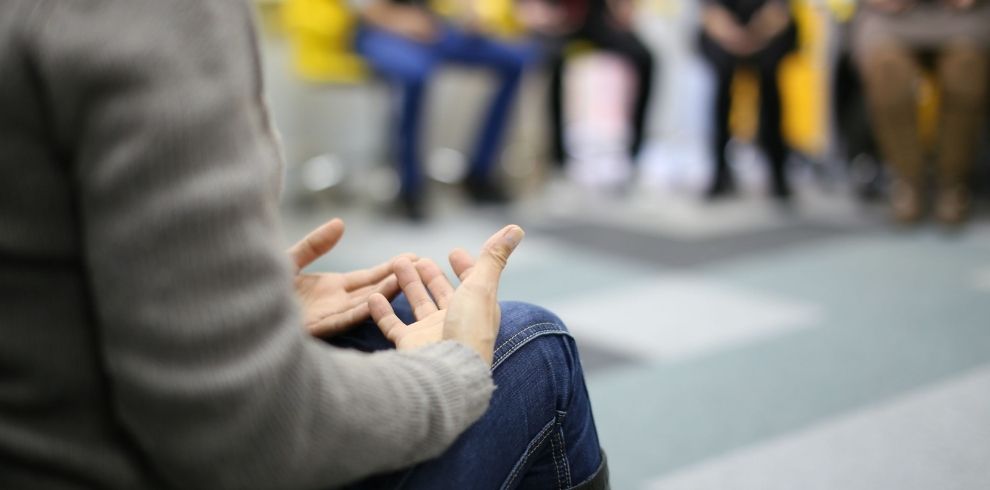
The Recovery Toolbox is an eight-week group for adults managing mild-to-moderate substance use symptoms, meeting Tuesdays from 2–3:30 p.m. in person at the Della Cava Family Medical Pavilion.
We recognize that the pull toward a substance does not usually come from a single place, so a single technique won't cover it. The group builds four skills for four kinds of triggers:
Creating mindfulness
For autopilot triggers: the drive home, the clock chiming 5 p.m. or visiting a familiar place where substance use is common. This skill helps to notice the cue and interrupt the reaction.
Learning distress tolerance
For emotional triggers: stress, anger, grief, boredom or trauma. When feeling distress, this skill helps to tolerate the urge as it crests and falls, without turning to a substance.
Building boundaries
For social triggers: visiting a person who always offers, a family event, a partner who drinks or uses a substance. This skill builds scripts and responses so declining and protecting boundaries isn't a fresh negotiation every time.
Developing recovery skills
For situational triggers: poor sleep, isolation, or a lack of structure to stay occupied. Building dependable routines is a skill that makes difficult choices less likely to occur.
“These tools will help to provide interventions that participants can use in real-time when faced with decisions on how they want to engage with substance use and flesh out why they maybe started using in the first place,” notes Amanda Wroblewski, LCSW, director of the PILLAR Program at BCH.
In a newer 2023 report from World Psychiatry, skills-based group intervention like Recovery Toolbox is the recognized evidence-based response for substance use causing mild-to-moderate interference in daily life. Abstinence is not required to participate in Recovery Toolbox; however, the group does expect all active members to be sober while attending.
Is the BCH Recovery Toolbox right for you?
You don't have to be in crisis to want different habits. The Recovery Toolbox is for adults 18 years and older navigating mild to moderate problematic substance use. If you feel stable enough to show up, do the work, and keep daily life moving forward while building skills to make different choices, the Recovery Toolbox is here for you.
What to expect when you attend
September is National Recovery Month, and the 2026 theme is Recovery is REAL — Restoring Every Aspect of Life. Restoration doesn't have to begin with a dramatic rupture,it often begins with curiosity.
Sessions are facilitated by Amanda Wroblewski, LCSW, and Taylor Bister, LCSW, of the PILLAR team.
How to register
Email the PILLAR team at recoverytoolbox@bch.org by Monday, Sept. 21 to register for the first course beginning Tuesday, Sept. 22. One of our facilitators will reach out to ensure a good fit and complete registration.
Registration is required, and walk-ins are not permitted.
The Recovery Toolbox is an insurance-billed program that is often covered by a patient’s health insurance. Participants are encouraged to check with their insurance company to ensure coverage for the course.
Sources
- https://www.samhsa.gov/data/report/2024-nsduh-annual-national-report
- https://www.samhsa.gov/data/data-we-collect/nsduh-national-survey-drug-use-and-health/state-releases
- https://bouldercounty.gov/news/people-in-boulder-county-warned-to-take-caution-with-dangerous-fentanyl-circulating-in-illicit-drug-supply/
- https://assets.bouldercounty.gov/wp-content/uploads/2026/05/180235151_2025_annual_drug_report_accessible2.pdf
- https://www.americashealthrankings.org/explore/measures/ExcessDrink/CO
- https://pmc.ncbi.nlm.nih.gov/articles/PMC10168177/
- https://www.samhsa.gov/about/digital-toolkits/recovery-month