Dense breasts, explained: What your mammogram is telling you, and what it isn’t
- Category: General, Women’s Health
- Posted On:
- Written By: Boulder Community Health
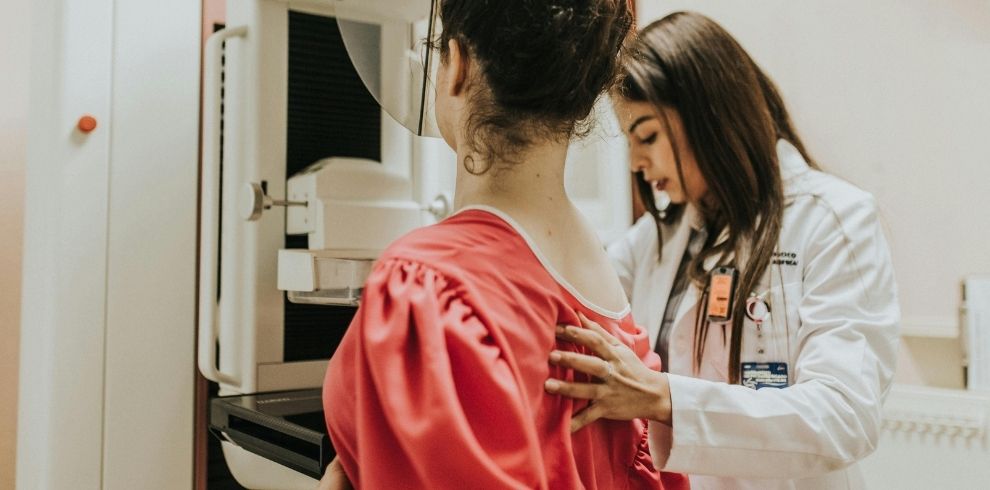
Breast density has become a much bigger part of the conversation about women’s health in recent years, but is still widely misunderstood. Since 2009, states have slowly been implementing disclosure rules leading up to September 2024, when a federal rule change required every mammogram report in the U.S. to tell women their breast density level. Many women heard the term for the first time on a report they received after a routine screening. Although it can seem daunting, the rule exists so women have the information—it doesn’t mean more women suddenly have a problem.
Breasts are made of a mix of fatty tissue and fibrous and glandular tissue. According to the CDC, if there is more fibrous and glandular tissue than fat, the breasts are dense. Within that description, breast density is broken up into 4 categories:
- A: entirely or almost entirely fatty, which occurs in about 10 percent of women
- B: scattered areas of fibroglandular density (or a few areas of dense tissue through the breast), which occurs in about 40 percent of women
- C: heterogeneously dense (considered “dense breasts”), which occurs in about 40 percent of women
- D: extremely dense, which occurs in about 10 percent of women
Density is mainly about what the mammogram can see, and what it cannot. On a mammogram, fatty tissue looks dark and dense tissue looks white. Tumors also look white, as we see in the depiction from the CDC. 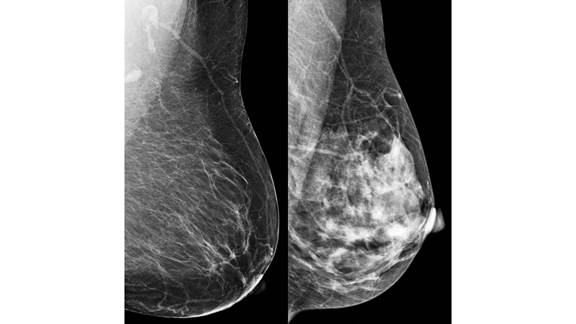
Reading a mammogram of dense breasts is a bit like looking for a snowball in a snowstorm. The equipment is working fine, it is just harder to see clearly and to correctly diagnose.
That is why your imaging team pays close attention to density. It tells them how confident they can be in what the image shows, and whether another kind of image might give a clearer look.
What are the risks of having dense breast tissue?
The Breast Cancer Research Foundation does cite that having dense breasts is linked to a modestly higher risk of breast cancer on its own. For women with the densest tissue, the risk is about twice that of women with average density according to some of the latest research found in the 2022 edition of The Breast. While much higher numbers can be found online; however, they mostly come from older film mammography studies. As the numbers still seem high; on the other hand, there is some reassurance—women with dense breasts are not more likely to die of breast cancer.
In Another study, the CDC found many factors affect breast cancer risk—family history, genetic markers, health conditions and lifestyle—and density is just one your care team can identify early. Because of this, women with dense breasts tend to find out earlier about a diagnoses. This balances the survival rate to equal that of women with less dense breasts.
Regardless of the more nuanced risks with denser breasts, being called back or offered more imaging, such as an ultrasound or MRI, usually means “we need a clearer look.” And that can still rattle you a bit. However, according to the American Cancer Society fewer than 1 in 10 women who are called back for more tests are found to have cancer. A callback is part of how screening works, especially when the tissue is dense and the first picture isn’t clear enough.
Stay prepared and bring these questions with you to your PCP.
- What category is my breast density?
- Given my density and history, is a regular mammogram enough for me?
- Would 3D mammography, ultrasound or MRI make sense?
- How often should I be screened?
We’re here to help you understand your results
Dense breasts are common, normal and not a fault. They’re simply one more thing your care team considers to get the clearest possible picture of your health.
Learn more about breast density with Dr. Susan Hagen of Boulder Valley Surgical Associates (BVSA):